“The wakas or the canoes, that is another way we determine kinship throughout the whole Pacific. We’re related by our canoes.” - Cindi Alvitre (Gabrielino~Tongva)
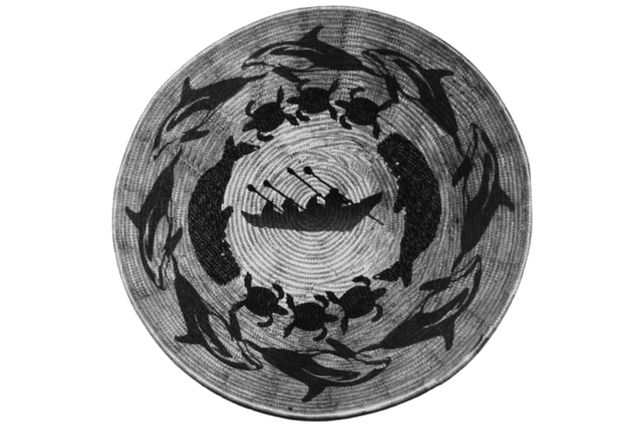
For thousands of years the Gabrielino~Tongva were master seafarers of the Southern California coast, reaching the Channel Islands in their sewn-plank canoes, known in the Tongva language as “ti’at.” The maritime culture that flourished due to the ti’at allowed Tongva to have permanent island villages, primarily on Pimu (Catalina Island), that would trade in reciprocity with those on mainland Tovaangar and beyond.
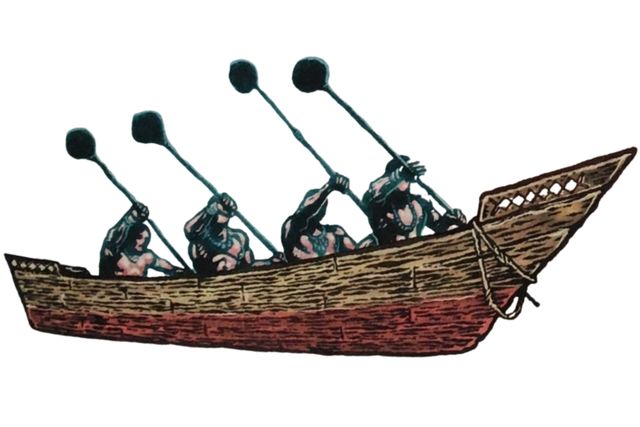
The Tongva and their Chumash neighbors to the North are the sole Native peoples in North America to traditionally build sewn-plank canoes, as opposed to dugout canoes made from single tree trunks. The only other Indigenous Americans to use this technology are in the Southern tip of Chile. The practices of building, caring for, and passing down ti’at were put to sleep following Spanish colonization as Native peoples were taken from island and mainland villages and forced into labor at Mission San Gabriel and San Fernando. For nearly 200 years, ti’at building had completely stopped within Tongva communities, until the Moomat Ahiko (meaning Breath of the Ocean) was built and taken into the water in the 1990s, reawakening the ancestral practice. The creators of the Moomat Ahiko would go on to found the Ti’at Society, an organization that promotes maritime culture and activities for the Native peoples of Southern California.
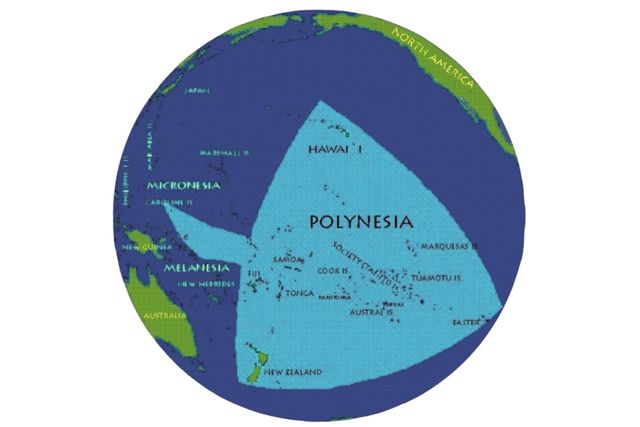
Pacific Islanders are arguably the best ocean navigators in human history, navigating the vast Pacific Ocean to make home in thousands of uninhabited islands over millennia. The area now known as Polynesia is encompassed by Aotearoa/ New Zealand in the East, Hawai’i in the North, and Rapa Nui/ Easter Island to the West, creating a triangle holding many islands within it such as Sāmoa, Tonga, Mā’ohi Nui, Tuvalu, etc. We know that Polynesians and Indigenous Americans had contact prior to other populations reaching the Americas, as Polynesians have cultivated sweet potatoes since around 1,000 CE. The wild ancestor for sweet potatoes is native to Central and South America, and the vegetable we know today was domesticated by Native peoples over 5,000 years ago. The word for sweet potato in some Polynesian languages even derives from a Quechua name “k’umar.” We invite you to imagine the connections Tongva and Polynesians may have had, as navigators and relatives of the Moomat/ Moana/ Pacific Ocean.
Ti’at, Va’a
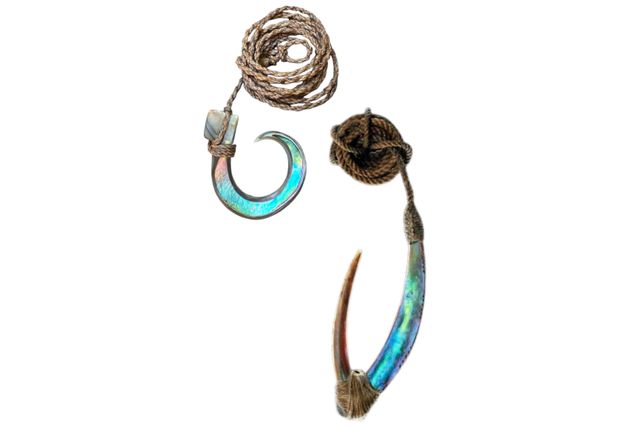
Canoe building has always been an integral part of both Tongva and Polynesian cultures. Ti’at are traditionally built by sewing together wooden planks with plant cordage (dogbane or hemp), then sealing the planks together with waterproof adhesive (primarily tar), and sanding the boat with sharkskin before decorating. Many Polynesian plank canoes, called va’a/ waka, are built very similarly. Being sewn together with natural cordage (coconut or flax) then sealed with breadfruit tree sap or other fibers, and sanded with sharkskin.
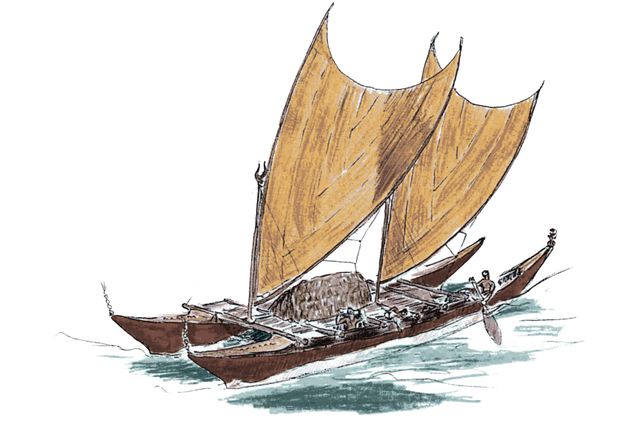
Canoes are transporters of many things, from seashells, to art, to loved ones, and spiritual power. The Sāmoan islands of Manu’a are known for their mana, or spiritual power that spreads throughout the Pacific. In old times, Tongva knew healers/ medicine people on Pimu (Catalina Island) to have special abilities, being able to cause earthquakes and speak with the ocean in order to calm it for ti’at crossings. The Hawaiian island of O’ahu has a famous story of four māhū/ two spirit healers sailing from Tahiti to Waikiki in order to share their spiritual abilities.
Ongoing Relations
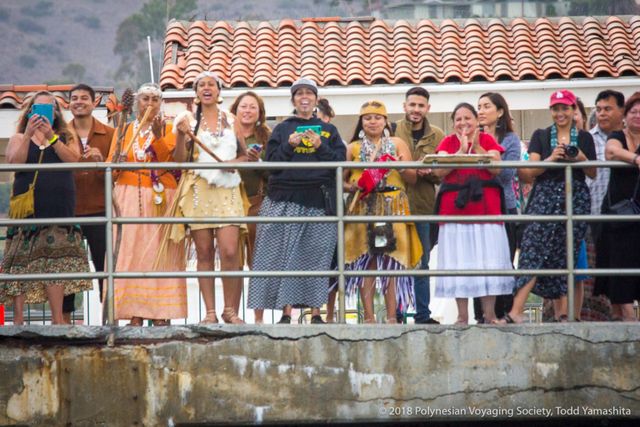
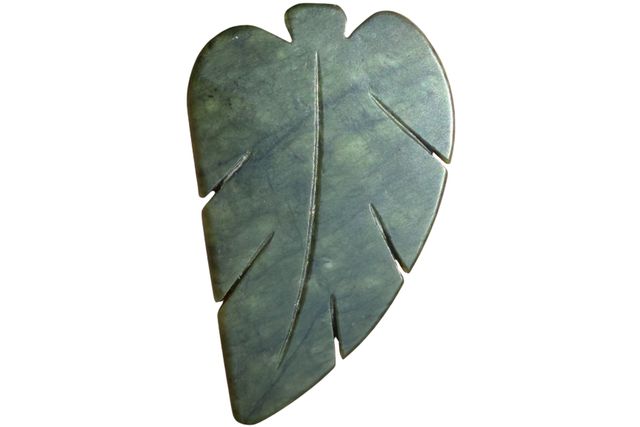
The relationship between Tongva and Polynesian peoples is immemorial, and the Pacific Ocean has always been the conduit of this bond. In 2018, members of the Tongva community welcomed the Polynesian Voyaging Society on the Hikianalia vessel to Pimu with songs and gifts. Here at Kuruvungna Springs, a Māori tekoteko (ancestral carving) named Hineraukatauri lives in our Museum/ Cultural Center, carved from a 4,500 year-old kauri tree by master carver James te Taonui a Kupe Rickard. In 2025, Māori curator and cultural activist Kararaina Te Ira gifted the Springs a leaf carved out of pounamu (greenstone) from the sacred Arahura river as a token of mana and mauri (life force). We invite you to explore Kuruvungna’s Pasifika Garden near our kiiy. By growing shooxarvetam (plant relatives) from the Pacific such as taro and banana, the Springs continues to honor this ancient and ongoing TransPacific connection.
Sources
-
Te Ira, Kararaina. Māori. Aotearoa, New Zealand. “A Pounamu (greenstone) gift.” Oral teaching shared at Kuruvungna Springs Museum and Cultural Center, June 7, 2025. ↩︎
-
PBS SoCal. “Rethinking the Coast With the Ti’at Society | Tending Nature | Season 2, Episode 1,” November 4, 2019. https://www.youtube.com/watch?v=aJSlv7KZmzA. ↩︎
-
Yamashita, Todd, and Todd Yamashita. “Hikianalia Update | Oct 23, 2018: A Tongva Welcome Is Like No Other.” Hōkūleʻa, October 23, 2018. https://worldwidevoyage.hokulea.com/hikianalia-update-oct-23-2018-a-tongva-welcome-is-like-no-other/. ↩︎
-
James Wharram Designs. “Lessons From the Stone Age Sailors - James Wharram Designs.” James Wharram Designs - Unique Self-build Sailing Catamarans, Inspired by the Double Canoes of the Polynesians, October 24, 2024. https://www.wharram.com/articles/lessons-from-the-stone-age-sailors/. ↩︎
-
“Kuruvungna Sacred Springs | Santa Monica Conservancy,” n.d. https://smconservancy.org/property/kuruvungna-sacred-springs/. ↩︎
-
Parks, California State. “Malibu Lagoon Chumash-Polynesian Connection.” California State Parks, n.d. https://www.parks.ca.gov/?page_id=24433. ↩︎