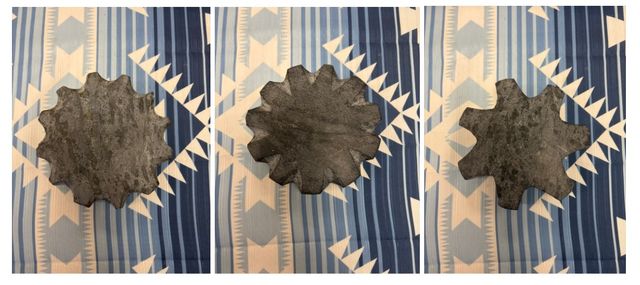
What is a “Cogged Stone"?
Here in the Kuruvungna Village Springs Museum we feature Gabrielino/Tongva cultural items as living relatives. We are guided by principles of cultural stewardship, reciprocity, and respect for the sacred nature of many cultural holdings. When viewing the cogstone wheel, think about how it carries meanings and has a relationship with the land and the people associated with them, this can be from what it might be used for, who would have used it, the material used in its creation, and the multiple meanings and uses that can come from it. These artifacts, such as the cogged stone wheel, have a deeper connection to their surroundings. By thinking of our surroundings in this way we can begin to decolonize our understandings and how we approach museum practices and standards. Throughout this page you will see these notions explored with the Kuruvungna Village Springs Museum in mind.
Relationship with the Land and Water
Cultural holdings featured at Kuruvungna Village Springs maintain a historical and ongoing spiritual and cultural meanings directly from its origin and life journey. This includes recreations, such as the cogged stone wheels. The usage of these cogstones are up for debate amongst archaeologists. Some of their hypotheses include; uses for fishing, entertainment or games, projectiles, and even as ceremonial or funerary uses.
As we begin to think about ideas of intended purpose or the materials used for their its creation, we ask you to consider the following question(s):
- How do these concepts relate to holdings back to the land and the people who it comes from? This is through a signifying relationship between the symbol, the cogged stone wheel, and its meaning, which can be up to the viewer’s interpretation.
- How do you imagine the cogged stones could have been used?
- How would you use them respectfully today?
Understanding the Materials
Researchers have used methods to approach geological compositions for cogstones that direct their materials to several locations across Southern California. The geological material largely used is a volcanic rock, or basaltic scoria, which is a porous and dark colored material. Matches for the material came back from locations such as; the Santa Rosa Plateau, the Santa Ana Mountain region near Murrieta, with possible matches drawn towards Santa Catalina/Pimu.
Museum Practices
When thinking about other museums that you have visited in the past, did the collections have a greater impact on you when you had a connection to what you are viewing? By viewing museum practices in this light, it helps build a conversation with the people and what they are viewing. When using museum language and speech, it should be simple and brief, but visually interesting that it grabs the attention of a visitor. This speech should also stray away from stereotypes about indigenous communities.
Museum displays should also focus on creating an environment that fosters knowledge as well as sensory experience with the cultural holdings. Focusing on cultural beliefs and ethics with museum curation fosters an ethical approach to viewing the relationship and responsibilities between the people and cultural holdings with the Kuruvungna Village Springs.
Interactive Activity: Semiotics / Material Culture
People thrive on meanings. These meanings help explain the context of everyday life. Through the interpretation of meanings or signs, such as words, sounds, sensory impressions. These signs signify something that we can comprehend. To break this down, you can think of semiotics in this way:
A signifier: a form in which the sign manifests itself.
Signified: the concept the signifier can represent.
Icon: signifier is seen as signified, this can be through
sensory or possessing the same qualities
Think about a cultural holding within the museum. What do you notice? What does it represent or communicate? Consider its meaning, history, and relationship. Keep in mind what you have learned so far in this panel and apply that knowledge to your surroundings. There is not a right or wrong answer so feel free to think of how these cultural holdings relate back to our environment.
References
-
Atkin, Albert. “Peirce’s Theory of Signs.” Stanford Encyclopedia of Philosophy, October 13, 2006. https://plato.stanford.edu/entries/peirce-semiotics/. ↩︎
-
Cooper, Karen Coody, and Nicolasa I. Sandoval. Living Homes for Cultural Expression: North American native perspectives on creating community museums. Washington, D.C: National Museum of the American Indian, Smithsonian Institution, 2006. ↩︎
-
Kuruvungna Village Springs. Accessed August 30, 2026. https://kuruvungna.org/. ↩︎
-
Ramos, Debra Cano. “Geologists Identify Rock Source of Native American Cogged Stones from Orange County.” CSUF News, February 5, 2025. https://news.fullerton.edu/2021/03/geologists-identify-rock-source-of-native-american-cogged-stones-from-orange-county/. ↩︎
-
“Semiotics for Beginners: Signs.” Princeton University. Accessed August 30, 2026. https://www.cs.princeton.edu/~chazelle/courses/BIB/semio2.htm. ↩︎
-
For more background on this Alabama series and a discussion of two photograph albums in the collection of the Prints and Photographs Division of the Library of Congress thought to beEvans’s “first draft” for Fortune, seeJudith Keller and Beverly Brannan, “Walker Evans: Two Albums in the Library of Congress,” History of Photography 19:1 (Spring 1995). ↩︎